Friday Fun: Welcome to the Corporate Circus
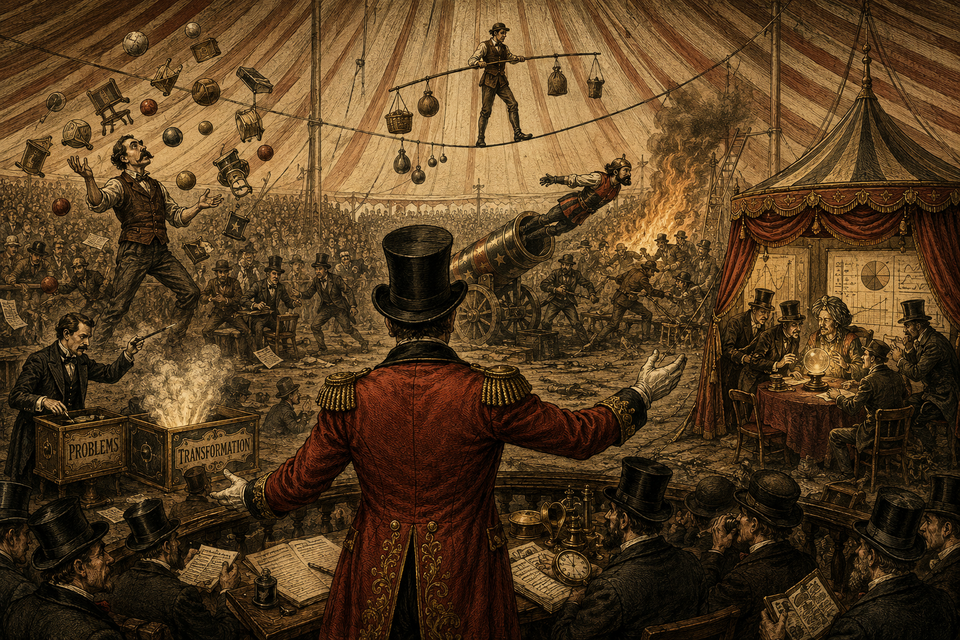
Last weekend I visited a travelling circus.
At least, that is what the sign outside claimed.
The tent itself looked unusually familiar. The promotional material promised innovation, excellence, transformation and customer obsession. The audience appeared reassured by these declarations, although I noticed that nobody seemed entirely certain what they meant.
Curiosity compelled me to purchase a ticket.
Inside, a gentleman in a red coat and black top hat welcomed us warmly and assured us that everything was proceeding exactly according to plan. The audience applauded politely. Several people visibly relaxed.
I made a note of this.
The show had not yet begun.
The Great Juggler
The Great Juggler is among the circus's most admired performers and can usually be identified long before he enters the arena. He travels with assistants carrying notebooks, schedules and several urgent matters which, judging by their handlers, appear capable of becoming catastrophic at any moment.
His performance consists of keeping objects in the air.
At first there are only a few. A customer request. A strategic initiative. A quarterly objective. Soon additional objects arrive. Escalations are introduced. Transformation programmes appear. Committees emerge. Before long the air above the arena resembles a migratory flock.
The audience watches in admiration.
The remarkable thing is that nobody appears particularly interested in the objects themselves. Spectators discuss the quantity of objects, the speed of the performance and the extraordinary effort required to sustain it. They rarely discuss where the objects came from, whether they remain useful or when they might eventually return to earth.
One young visitor asked whether the performance would end once all the objects had been successfully delivered.
His father explained that this was not how juggling worked.
The child appeared disappointed. The adults appeared satisfied.
As I left the arena, I noticed several assistants preparing additional objects for the following performance.
The Juggler, it seemed, had become a victim of his own success.
The Fortune Teller
The Fortune Teller occupies a smaller tent near the edge of the circus grounds. Despite its modest size, it attracts some of the longest queues in the entire establishment.
Executives arrive before sunrise. Consultants arrive shortly afterwards. Investors arrive carrying notebooks. Journalists arrive carrying conclusions they hope to validate.
The Fortune Teller receives them all with equal enthusiasm.
The future, according to today's performance, will be transformed by artificial intelligence. Last year's programme suggested a somewhat different future, although this appeared not to trouble anyone present. The audience seemed far more interested in tomorrow's certainty than yesterday's accuracy.
What struck me most was the confidence.
Predictions were delivered with absolute conviction. Markets would change. Customers would evolve. Competitors would disappear. Entire professions would vanish.
The audience listened attentively.
One gentleman asked whether any of these outcomes were guaranteed. The Fortune Teller smiled kindly and explained that certainty was impossible.
The audience appeared relieved. The prediction continued unchanged.
As I departed, I noticed that many visitors emerged carrying answers. Few appeared to leave carrying questions.
The Illusionist
The Illusionist performs in the main arena and enjoys an excellent reputation.
His act is surprisingly simple.
A problem is brought onto the stage. The audience studies it carefully.
It might be technical debt. It might be organisational confusion. It might be a delayed project, an unclear strategy or a disagreement nobody wishes to address directly.
The Illusionist approaches. A dramatic gesture follows. The problem receives a new name. The audience applauds.
At first I assumed I had misunderstood the performance. Surely there was another stage of the act. Perhaps the problem would disappear. Perhaps it would be transformed into something useful.
Instead, the next problem was introduced.
The process repeated.
To be fair, the Illusionist possesses genuine talent. It takes considerable skill to persuade an audience that renaming something has altered its nature. Several spectators could be heard discussing the elegance of the solution while the original problem remained visible a few metres away.
The performance concluded with a standing ovation.
The problems also remained until closing time.
The Human Cannonball
Few attractions generate more excitement than the Human Cannonball.
The principle is straightforward.
Whenever an unexpected difficulty emerges, the Human Cannonball is launched directly towards it.
The audience loves this act.
There is something deeply satisfying about watching a difficult situation resolved by courage, expertise and determination. The performer never disappoints. Deadlines are rescued. Customers are reassured. Technical failures are corrected. Crises disappear.
The applause is entirely deserved.
What puzzled me was the frequency of the performance.
By the third act, I began noticing that many of the circus's most ambitious attractions appeared strangely dependent upon the Human Cannonball's availability. Risks that might once have seemed excessive were accepted without hesitation. Schedules became increasingly optimistic. Contingency plans became increasingly theoretical.
Whenever concerns were raised, somebody pointed discreetly towards the cannon.
The audience interpreted this as confidence. The Human Cannonball looked tired.
The Tightrope Walker
The Tightrope Walker performs high above the arena and receives considerably less attention than he deserves.
Unlike the other performers, he rarely generates headlines. His act contains no explosions. There are no dramatic predictions. No illusions. No applause lines.
Instead, he spends the evening making small corrections. A slight adjustment here. A subtle shift there. A careful redistribution of weight.
From below, the performance appears effortless. The audience often uses words such as "stable", "predictable" and "under control".
The Tightrope Walker would probably find these descriptions amusing.
Several times I observed conditions changing unexpectedly. New weights appeared on the rope. Existing assumptions shifted. External forces began pushing from unexpected directions.
Each time, the performer adjusted. Most spectators never noticed.
That, I eventually realised, was the point.
The greatest compliment a Tightrope Walker can receive is to remain invisible.
The Ringmaster
By the end of the evening I had become increasingly interested in the Ringmaster.
He seemed to appear everywhere. Before every performance he reassured the audience. After every performance he celebrated success.
Whenever uncertainty emerged, he translated it into confidence.
The audience clearly appreciated this service. In fact, they seemed to demand it.
The circus itself appeared far too complex for any single individual to fully understand. Hundreds of performers moved independently. Problems emerged unexpectedly. Equipment failed. Plans changed. New opportunities appeared while existing assumptions quietly expired.
Yet every evening the audience expected somebody to stand in the centre of the arena and explain what would happen next.
The Ringmaster accepted this responsibility with remarkable composure. Whether he possessed any greater certainty than the rest of us remained unclear.
The audience did not appear interested in finding out.
Closing Time
As the crowd departed and the lights began to fade, I found myself reflecting upon the performers I had encountered.
- The Great Juggler had become famous for keeping things moving.
- The Fortune Teller had become famous for explaining the future.
- The Illusionist had become famous for explaining the present.
- The Human Cannonball had become famous for rescuing difficult situations.
- The Tightrope Walker had become famous for preventing them.
- The Ringmaster had become famous for reassuring everybody that the show could continue.
None of them appeared irrational. None of them appeared malicious. Each seemed perfectly adapted to the environment in which they operated.
As I left the circus grounds, I finally understood why the place had felt so familiar from the moment I arrived.
This was not a circus pretending to be a company. It was simply a company viewed from a sufficient distance.
Member discussion