Friday Fun: TicketOps Anonymous
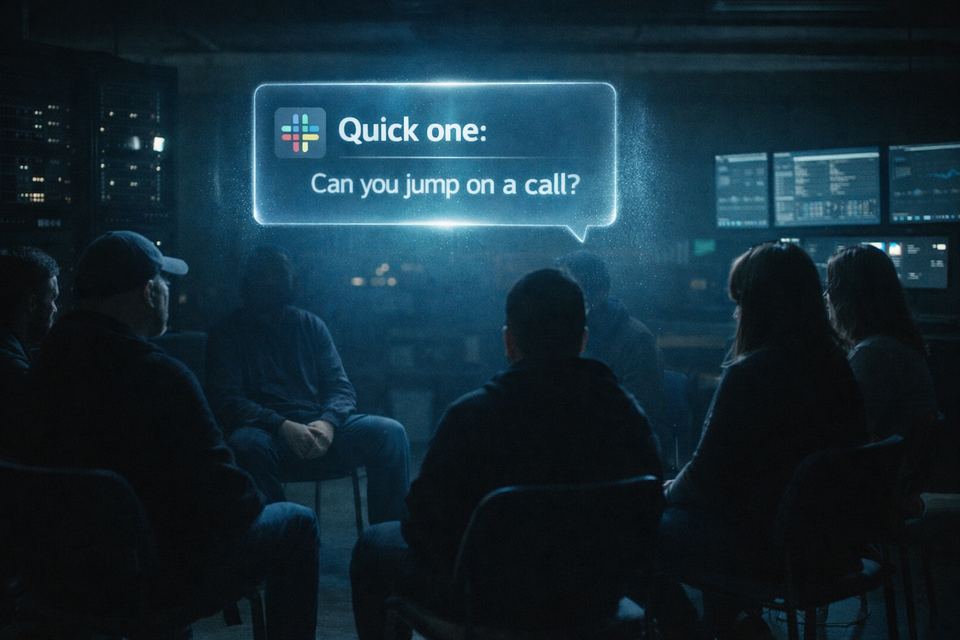
Hello.
My name is Platform.
And I have not built anything reusable in 47 days.
Hi, Platform.
I remember when I had ambitions.
Reusable components.
Self-service configuration.
Elegant contracts.
Systems that scaled without meetings.
I had diagrams and principles.
I had a roadmap where "urgent" was an exception, not a theme.
Now I answer Slack messages that begin with:
"Quick one."
There is no such thing as a quick one.
There is only a small incision into your architecture.
At first it feels noble.
"We are here to help."
We fix a config.
We tweak a limit.
We manually run a script.
We unblock a team.
Everyone claps.
We feel useful.
Dopamine achieved.
Then it becomes structural.
People stop reading docs.
Interfaces become suggestions.
The backlog becomes a museum of exceptions.
And slowly, silently, Platform becomes a concierge service with architectural aspirations.
We still use impressive language.
"Enablement."
"Acceleration."
"Strategic partnership."
In practice:
• We deploy patches for misunderstandings.
• We attend incidents for decisions we did not make.
• We maintain systems nobody remembers designing.
• We join calls that could have been prevented by a contract.
And we call it agility.
A typical dialogue.
Product: "We just need a small exception."
Platform: "The contract does not allow it."
Product: "It is temporary."
Platform: "Temporary becomes precedent."
Product: "Can you just help this once?"
Platform: "That is what we said last quarter."
Product: "The business needs speed."
Platform: "The business needs structure."
Silence.
Platform joins the call.
The exception ships.
The contract becomes folklore.
There are stages in my TicketOps dependency.
Let me tell you how I lose myself.
Stage 1: Innocence
You tell me, "We just need help this once."
I believe you.
Stage 2: Familiarity
You ask, "Can you jump on a quick call?"
I jump.
Stage 3: Expectation
You say, "We assumed you would handle it."
I do.
Stage 4: Identity
I handle it.
Always.
Even when I should not.
The most dangerous sentence you say to me is:
"Platform will take care of it."
It sounds collaborative.
To me, it feels like architectural erosion.
And here is the twist.
TicketOps feels productive.
Tickets close.
Threads resolve.
Dashboards turn green.
Stand-ups feel busy.
The system, however, grows softer.
Interfaces blur.
Ownership melts.
Strategy moves to "next quarter."
But Slack remains active.
So everything looks alive.
At some point, someone suggests automation.
"Can we AI the triage?"
Yes.
Of course.
We will build a model that prioritises chaos.
We will deploy an LLM that politely apologises for architectural drift.
We will create a dashboard showing response-time excellence.
The backlog will remain.
But now it will have confidence scores.
We will not have solved leverage.
We will have quantified reaction.
We will present a slide titled "Operational Excellence."
It will contain charts.
It will not contain boundaries.
And everyone will nod, relieved that the chaos now has analytics.
Meanwhile, my best friend Leverage stopped calling.
Leverage used to sit quietly in the corner.
No drama.
No escalation.
Just compounding value while I protected boundaries.
But I discovered dopamine.
Slack notifications.
Resolved tickets.
Public praise for "jumping in."
Leverage does not compete with applause.
Leverage does not send emojis.
Leverage does not trend in stand-up.
So I chose the louder friend.
Because boundaries create friction.
And friction feels impolite.
And I am addicted to being needed.
So instead, I optimise politeness.
I optimise availability.
I optimise response time.
And somewhere along the way,
Leverage left the room.
Leverage never unfollowed me.
I just stopped answering.
I optimised myself out of platform status.
There is an irony I try not to see.
We say we want scale, yet we reward immediacy.
We say we want systems, yet we celebrate heroics.
We say we want ownership, yet we route responsibility through Slack.
We say we want leverage, yet we measure popularity.
And popularity scales faster than architecture.
Friday confession.
TicketOps is not a capacity problem.
It is a courage problem.
But here is the uncomfortable truth.
They did not do this to me.
I volunteered.
The courage to publish contracts.
The courage to say no.
The courage to let small friction exist.
The courage to let teams read documentation.
Because when I become the fire department, no one learns fire safety.
They just memorise the emergency number.
Hi.
My name is Platform.
I am one "quick one" away from becoming a helpdesk.
I still talk about leverage.
I still mention self-service.
I still believe in clean interfaces.
But for now, I reset passwords with dignity.
Happy Friday.
We will laugh.
We will react.
We will tag a few colleagues.
On Monday, we will open Slack.
And someone will write:
"Quick one."
And we will have forgotten this entire post.
If your sprint goal reads "survive," you are not inefficient.
You are popular.
And popularity rarely builds systems.





Member discussion