Friday Fun: How to Blow Up a Scale-Up
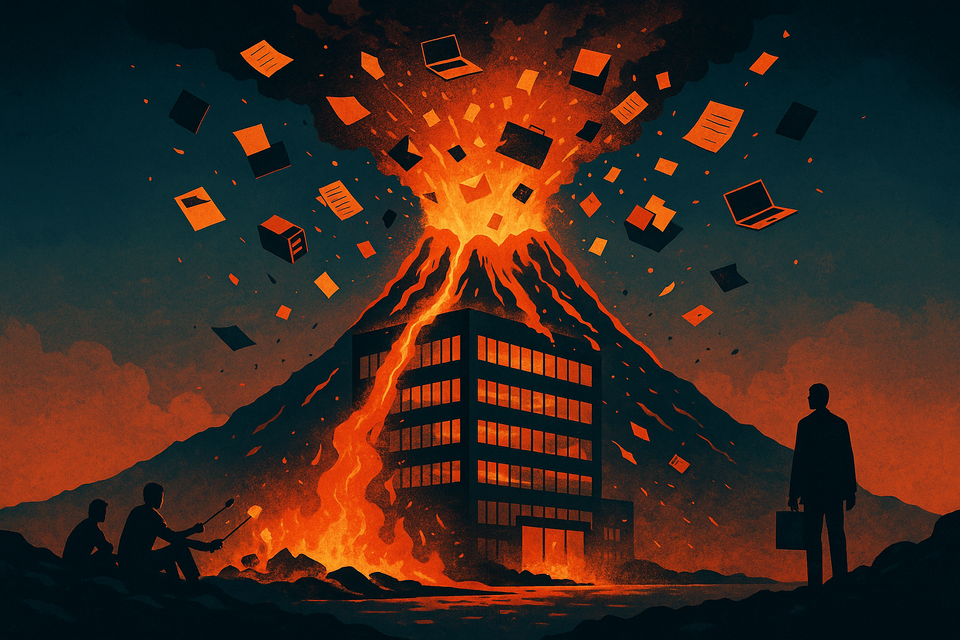
A cynical guide for those who believe chaos is a strategy
Let us not pretend. Companies rarely collapse because of a single catastrophic decision. They collapse because of hundreds of small, confident, foolish choices compounding over time. If you ever wished to observe organisational self-destruction in its purest form, here is the fastest route.
Follow it closely and you will tank your scale-up faster than a crypto token in 2018 !!!
Wrong Roles
A scale-up sabotages itself fastest by filling key seats with the wrong people and pretending nothing is wrong.
Product managers morph into part-time CTOs, dictating technology based on whatever trend surfaced that morning.
Engineers chase only glamorous work and avoid anything with operational weight. Leaders quote frameworks they neither understand nor apply.
"Idea people" produce visions without substance, flooding teams with noise.
Decision fatigue soon turns into truth fatigue: nobody believes anything, especially not plans.
Wrong Processes
Chaos thrives when process becomes optional theatre. Meetings replace alignment.
Sprints become vague suggestions. Definitions of Ready and Done vanish because they demand discipline. Release management becomes roulette. Retrospectives produce lists nobody intends to act on.
Leadership whims hijack plans weekly. Jira turns into an archaeological dig of abandoned civilisations. Everything moves but nothing completes.
Predictability fractures, morale erodes, and churn accelerates because good people refuse to operate in perpetual improvisation.
Wrong Engineering Practices (or Lack Thereof)
Negligent engineering is the fastest accelerant of collapse. Tests decay. Observability is an afterthought. Nobody knows the reliability of anything.
Incidents are patched, not understood. Ship-now-fix-later becomes a lifestyle. Staging environments exist only as myth. Outages become the primary cross-team communication ritual. Ownership evaporates to the point where every incident starts with: "Who built this?"
Hype technology replaces competence. Hackathons produce prototypes that die within hours. AI-generated code drifts into production unreviewed. Engineering identity collapses. Burnout increases. Resilience disappears. Churn becomes the only consistent metric.
Wrong Culture
Culture amplifies every failure. Toxic scale-ups reward noise, obedience, and performance theatre. People hire only those who feel safe and non-threatening. Customer-facing teams treat platform engineers as beasts of burden.
Leadership rewards tenure over talent and loyalty over truth. Metrics evolve into weapons. Politics replaces judgement. Values downgrade into wall posters. Feedback becomes radioactive.
Honesty becomes a liability. Truth fatigue spreads: people stop challenging anything because it never leads to change.
Heroes are celebrated for extinguishing fires they started. Cynicism grows. Morale collapses. The organisation enters a slow cultural freefall that no rebranding exercise can repair.
Diagnostic: How Close Are You to Implosion?
If you recognise more than three of these patterns, the organisation is not drifting; it is sliding. If you recognise more than five, congratulations: you can finish the job and graduate to the corporation level of serial killers, Theranos level.
Implosion Checklist
- Roles exist, but ownership does not.
- Processes happen, but outcomes never change.
- Engineers work hard, but systems stay fragile.
- Everyone talks about speed, yet nothing finishes.
- Leaders demand accountability, yet model none.
- Roadmaps shift weekly, without improvement.
- Metrics increase, value decreases.
- Meetings multiply, clarity evaporates.
- Heroes thrive, foundations rot.
- Truth feels dangerous, silence feels safe.
Warning Label
The more these behaviours feel "normal", the closer you are to structural failure. Collapse is never sudden. It is incremental, predictable, and entirely self-inflicted.
Final Blow
Collapse is rarely a surprise. It is a habit.




Member discussion