Clarity Is the First Platform
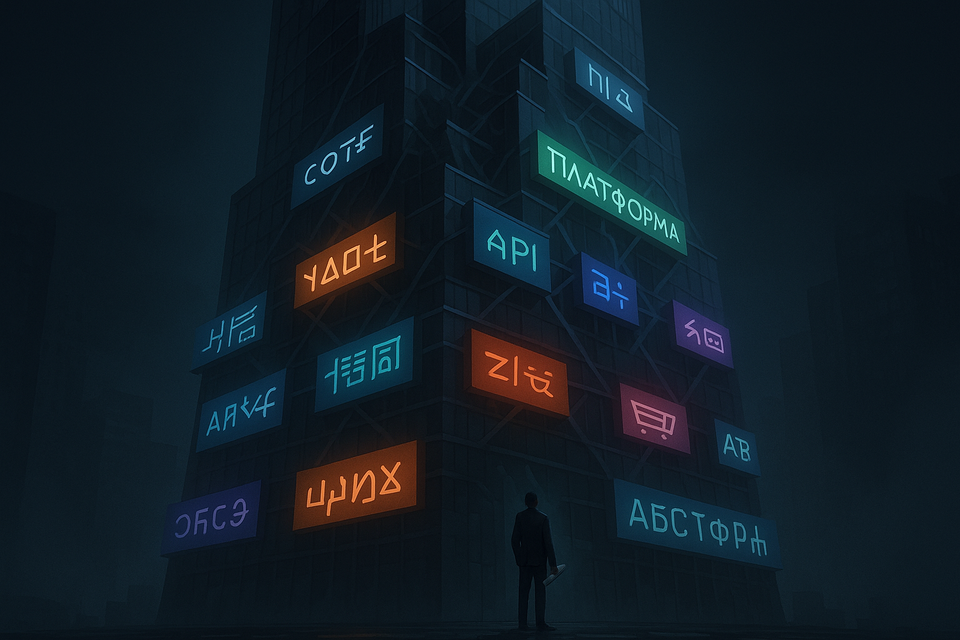
Every broken platform begins with a broken language. Semantic decay is the quietest organisational failure, and the most lethal. Systems drift, decisions degrade, and people hide behind vague words they never define. Then they blame engineering for the wreckage they created.
Organisations do not fall because they lack talent. They fall because they tolerate ambiguity, because they let meaning rot, and because they allow teams to operate with incompatible mental models. Once language fragments, alignment becomes performance. Delivery becomes theatre. Decisions become noise.
When language collapses, everything collapses behind it.
The Politics of Ambiguity
Ambiguity survives because it serves people.
Stakeholders use it to justify demands. Product uses it to avoid choosing. Design uses it to replace architecture. Leaders use it to protect themselves from accountability. Ambiguity creates comfort for those who fear ownership and cover for those who fear truth.
The organisation pretends it speaks a common tongue while every team operates with a private dictionary. Meetings create a false sense of alignment because everyone hears the same words and imagines different systems.
Ambiguity is not an accident. It is a political weapon.
Why People Fill the Void
When nothing has a name, people improvise. They describe imagined features instead of concrete problems because the system gives them no vocabulary for anything deeper. They latch onto surfaces because surfaces are the only stable reference point.
Nature hates emptiness. Organisations hate it even more.
Give people a void and they will fill it with fantasies: requests, toggles, imagined workflows, ad‑hoc integrations, and invented constraints. They call these "requirements". In truth, they are symptoms of a system with no grammar.
Without a shared language, stakeholders cannot describe reality, so they describe desire.
The Damage to Platform Teams
Platform teams carry the cost of every vague word. They receive contradictory expectations presented as urgent needs. They absorb the tension created by poor framing. They spend time negotiating meaning instead of building systems.
Boundaries erode. Trust fractures. Work becomes diplomacy instead of engineering. The platform becomes the organisation’s projection surface. Teams pull it in every direction and no one admits responsibility for the chaos.
A platform with no shared language becomes a hostage.
Your platform is not slow. Your language is.
Capabilities: The Grammar of the System
A system without grammar cannot be understood, aligned, or evolved. Capabilities give the organisation nouns and verbs that anchor reality. They form the structure that stops the organisation from drowning in opinions.
A capability is a boundary, a commitment, and a constraint. It defines what the system can do, what it refuses to do, and how it behaves under pressure.
When capabilities have names, stakeholders stop fantasising. When capabilities have boundaries, ownership becomes clear. When capabilities have definitions, the fog lifts and decisions accelerate.
Without capability grammar, every conversation becomes theatre and every roadmap becomes fiction.
Definition Is Not Ownership
One of the most destructive organisational myths is this: "Who defines it must own it."
False.
Definition creates clarity. Ownership distributes responsibility. Confusing the two destroys autonomy and breeds territorial conflict. A platform can define a capability without owning every operational detail of its lifecycle. A domain team can own execution without inventing definitions to suit its convenience.
Coherent systems scale because definition and ownership reinforce each other instead of competing.
The Discipline of What, Why, Why Now
Once capabilities exist, problem statements sharpen immediately. The structure forces clarity.
What forces teams to describe observable reality. Why forces them to justify its consequence. Why now forces them to choose.
Anything else is noise disguised as work. Teams that cannot answer these three questions are not communicating needs. They are expressing preferences.
This discipline removes every political hiding place. People confront facts instead of projecting fantasies.
Enablement Comes Last
Real enablement emerges only after three layers exist:
- Shared semantics
- Capability grammar
- Stable interfaces
Then, and only then, can teams operate autonomously with real speed and real safety.
Without these layers, "enablement" becomes corporate theatre: tools without context, autonomy without boundaries, and speed without understanding.
Enablement is not a feature. It is the consequence of linguistic discipline.
Preventing Drift
A language left unattended rots. Organisations must maintain it with the same seriousness they apply to architecture. They need periodic alignment loops, reality‑based updates, capability calibration, and confrontation with evidence. When the system evolves, the vocabulary must evolve with it. When vocabulary mutates without governance, the system fragments.
Semantic clarity is not a deliverable. It is a discipline. It is the foundation that keeps the organisation from collapsing into noise.
You cannot scale an organisation that cannot describe itself.
Clarity is the first platform. Everything else depends on it.




Member discussion